 Bruno Campos' Blog
by Bruno Campos
🙏 A Note Before We Begin
Before we climb this ladder together, a few important caveats.
First, this is written from the perspective of a professional in tech. More specifically, I work in data, so my examples and experiences lean heavily in that direction. The principles translate broadly, but your mileage may vary depending on your field.
Second, this entire article assumes you’re not a vibe coder. If you haven’t read my previous post on Intent Driven Development, the short version is: I’m not talking about throwing a prompt at an LLM and expecting a fully production-ready app to materialise. This assumes you’re tech literate, have some experience, and understand that agentic tooling is exactly that: a tool. Not magic. And like any tool, you need to learn the craft and master it before it becomes truly powerful.
Think of it like cars. A Ferrari in the hands of someone who can’t drive is just an expensive paperweight. A Skoda Fabia 1.0 litre with an F1 driver behind the wheel? That driver is going to win most races. The tool is only as good as the person wielding it. What I’m describing here assumes you’re the F1 driver: you can do most of the things you’re asking your agent to do, and at the very least, you have the knowledge base to review its output and guide it where it falls short.
With that said, I’ve been noodling on this framework for a while now. I’ve described these levels to coworkers, colleagues, and peers in the industry, and it’s resonated surprisingly well. It started as me trying to over-intellectualise a phenomenon (as I like to do) and turned into something genuinely useful for helping me onboard people into the world of agentic development.
So, where are you on The Agentic Enlightenment Ladder?
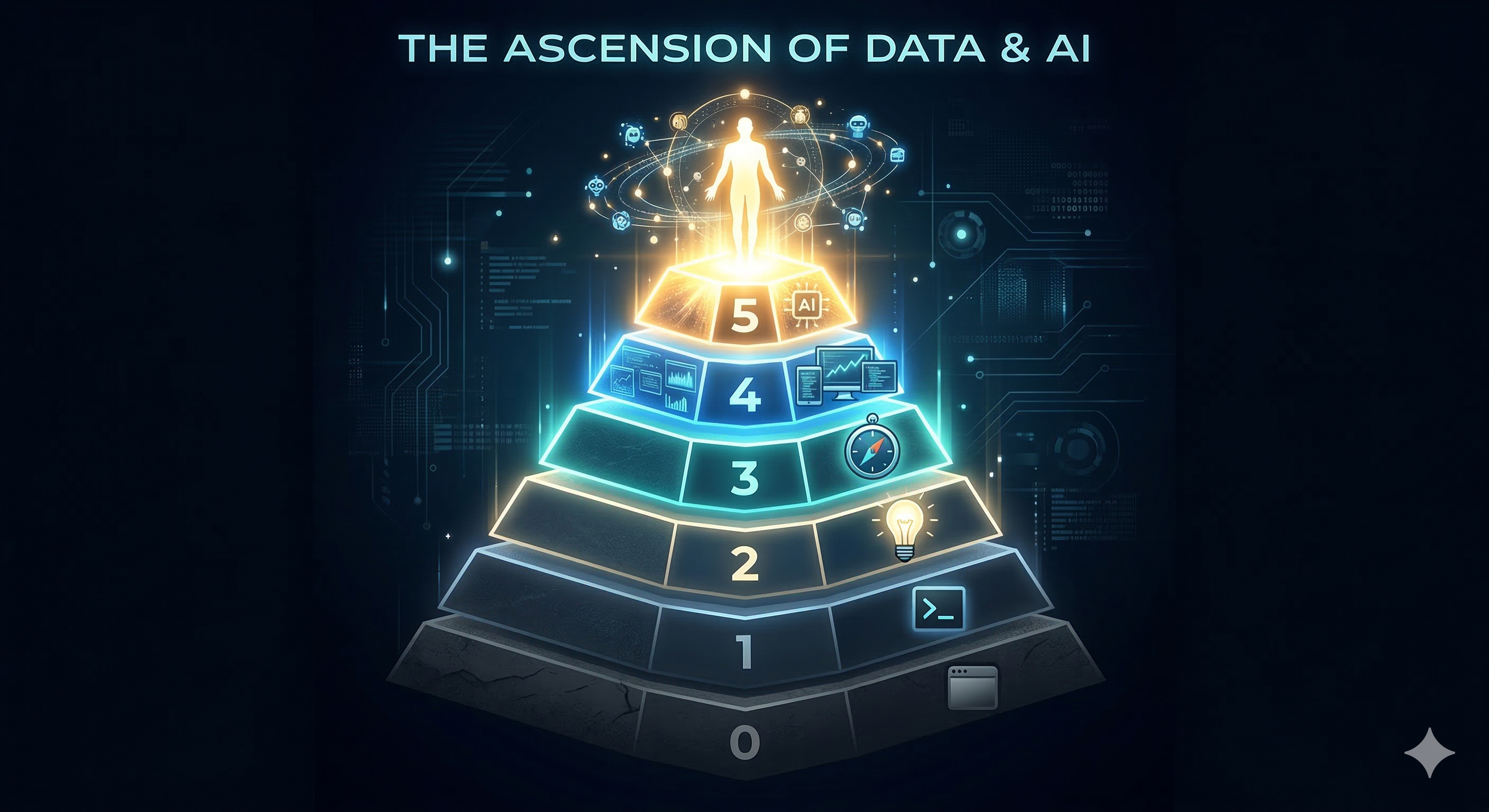 Obligatory AI-generated image. An article about AI without one felt illegal.
🌑 Level 0: The Sceptic
You know AI exists. You’ve heard the hype. Maybe you’ve even tried it a few times. But your workflow looks something like this: you’re in your IDE, doing most of the thinking and writing yourself. When you get stuck, you grab a chunk of code, open a browser tab, paste it into ChatGPT or Gemini, go back and forth a bit, copy the response, paste it back, tweak it, and carry on.
You appreciate the tool. It’s useful. But it hasn’t clicked yet. You haven’t unlocked that superpower everyone keeps banging on about.
At this level, you probably still see AI as a means to an end rather than a partner. You might even be somewhat sceptical. You’ve heard colleagues rave about it, seen the Twitter threads, but when you tried it the output was… fine? Not life-changing. You often choose to do things yourself because “it’s faster” or less cumbersome. And honestly? For simple tasks with your current workflow, you’re probably right.
You may have even dipped your toes into agentic tooling. Downloaded Cursor, tried Claude Code for an afternoon. But you either didn’t have enough time, or didn’t have the right use case, or just weren’t convinced for one reason or another. So you went back to what you know.
If this is you, you’re at Level 0. And that’s absolutely fine. Everyone starts here. The important thing is that you’re aware the ladder exists.
🌒 Level 1: The First Step
This is where the fun truly begins.
You’ve discovered local agentic tools. Cursor, Claude Code (current personal favourite), Gemini CLI, Codex, and others. You’ve taken a massive step because you no longer need to go back and forth between UIs, copying and pasting. You’re asking the agent directly, in your terminal or IDE, and you’re slowly recognising it as a partner rather than a search engine with attitude.
Getting here is a huge step. Some people never make it (more like haven’t yet, come on, these things have only been out for a couple of years). Their scepticism and fear keeps them away. If you’re asking questions like “is there a course you’d recommend for learning Claude Code?”, you’re not yet on the ladder. Here’s the thing: if a course exists for this, it’s a scam not great. The AI world changes so quickly that a structured course doesn’t make sense. By the time it’s published, half of it is outdated. And genuinely you have the best teacher already! The best way to learn is to just download the thing and start using it. There is no substitute for hands-on experience here.
At Level 1, you’re starting to see what all your friends have been raving on about. You start using it in your day-to-day work more and more. You’re stretching boundaries. You’re having those “wait, it can do THAT?” moments. You’re building trust, one successful interaction at a time.
Getting to Level 1 is a huge achievement. If you’ve spotted yourself here, give yourself credit. The jump from Level 0 to Level 1 is the biggest on the entire ladder.
🌓 Level 2: The Oroboros of Knowledge
At Level 2, you realise that your agentic tool is more than just a “doer”. It’s also a thinker, teacher, guide, and brainstorming partner.
Here’s a good litmus test: when you don’t understand something, or you’re confused about how to set up a Claude Code skill, or you want to know what a particular CLI flag does, what do you do? Do you search online, ask a colleague, or open the documentation? Or do you just ask the agent itself?
If it’s the former, you’re still at Level 1. If it’s the latter, welcome to Level 2.
This is a genuine shift in your workflow and your relationship with the tool. The internal monologue changes. You no longer think “Oh, I wish I had something that automatically reviewed my PRs for me… I’ve heard of skills, I need to read up on that later and get it sorted.” Instead, you approach your agent directly:
“This is my goal: I want to review my PR on my command. What do you recommend we use?”
“Oh what’s a command? That sounds cool!”
“Ok, now make me a command that gets my PR and reviews it for me like this…”
And just like that, the thing you wished for exists. You didn’t need to read documentation, watch a tutorial, or wait until you had a spare afternoon. You and your agent built it together, right there and then.
This is the oroboros of knowledge and creativity. You use the tool to learn about the tool. You use the tool to extend the tool. You are no longer bound by your lack of knowledge in any particular area because you have an incredibly capable partner that can fill the gaps in real time. This gives you immense independence and a compounding feedback loop of capability.
🌔 Level 3: The Explorer
Level 3 is about pushing your newfound powers to their limits, and eventually discovering what those limits are.
You’ve been on a tear. You’ve automated workflows, built skills, created custom commands, and integrated your agent into practically everything. But somewhere along the way, you start noticing the cracks. Despite your agent knowing vast amounts and being incredibly fast, it cannot do everything well. Not yet, anyway. (New models in the future? Real Gen-AI?? All questions to be answered, but for now, this is true.)
Here’s the thing though: this realisation isn’t a bad thing. You’ve already gained so much productivity that you’re more than okay knowing the tool isn’t perfect. You (especially if you already have the experience) can close that final 10-15% yourself, often by providing more specific prompts and targeted guidance rather than starting from scratch.
At this point, you’ve fully integrated agentic tooling as part of your workflow. Probably for everything (I have). You use it for code, documentation, debugging, learning, brainstorming, even to help you write blog posts that are coherent and less of a ramble (hello 👋). And you’re only frustrated that the other tools and platforms you use don’t have a CLI so you can just let your agent handle them too.
If you find yourself often hitting these genuine boundaries, you are at level 3. And you’re getting close to Level 4.
🌕 Level 4: The Bottleneck Is You
This is probably where most of us who use agentic tooling heavily find ourselves. And the core realisation here is both empowering and humbling: you are the bottleneck now. Going faster depends on you, not the tool.
At this point you probably have a strong workflow with your preferred tooling. You know its limitations and have created harnesses, skills, commands, and rules to cover most of the rough edges you encountered before. You’ve also built an immense amount of trust in the tool, having watched it prove itself again and again across countless tasks and projects. You know that most of the time (and I mean most), it’s going to get it right or come very, very close.
You are now fully empowered to go, go, go. But there’s one problem: you.
You’ve set up parallel agents. Multiple Claude Code sessions running in different terminals. Prompts that auto-launch subagents to delegate work. You’ve even written agents yourself (well, asked your agent to write them for you of course). But now you’re struggling to keep up. You’ve tried the full-throttle approach, six agents running simultaneously, and felt completely overwhelmed. The context switching between reviewing multiple parallel outputs, making architectural decisions for several workstreams at once, and keeping track of what each agent is doing and why… it’s a lot.
You’ve pushed the tool as far as you can on your own, and you know what you don’t know. You know what you could achieve with it. You have zero reliance on trivial external sources for information. It has truly become your partner. But it’s gone beyond that now. You realise you could have a whole team behind you whenever you want. But “managing” this team of agents is itself a skill you’re still developing.
At Level 4, the challenge shifts from mastering the tool to mastering yourself as a manager of tools.
🌌 Level 5: True Agentic Enlightenment
Honestly? I’m not here. I don’t know what this looks like yet.
But I envision something like Tony Stark with multiple Jarvis instances working on several projects simultaneously. Creating everything and anything. Controlling all of them, keeping an eye on all of them, pushing the boundaries of computational power even, agents looking after agents, and churning out multiple high-impact projects within weeks.
I genuinely have no idea what this looks like in practice. I don’t think many people are here yet either, though the denizens of X/Twitter might try to convince you otherwise. Some of those claims might be true, but statistically, surely it can’t be everyone??? The Digital Echo Chamber is very real, and it would have you believe that every developer on the planet is already orchestrating a fleet of AI agents delivering enterprise software before breakfast. Again, statistically, this cannot be true and I’m certainly sceptical.
And that’s the fun of calling this the Agentic “Enlightenment” Ladder. Intrinsically, enlightenment implies a “beyond”, a detachment from mere mortal human thought. I’m definitely hiding behind this carefully crafted terminology, but the point still stands: there’s a level above where most of us currently operate, and the exciting part is that none of us quite know what it looks like yet. The future looks fun.
🪜 Climbing the Ladder
I want to be clear here this framework should be taken lightheartedly. It’s not gospel. There might be more levels. There are almost certainly mini sub-levels in between. Some people might skip levels entirely or find themselves straddling two at once.
But I’ve found it genuinely useful, particularly when trying to convince, onboard, and get new people to try agentic tooling. For a long time now (having reached Level 3 about 9 months ago at the time of writing), I struggled to convince people to even try the thing in the first place. I couldn’t understand why people weren’t as excited as I was. And more importantly, I didn’t have the language to explain to myself what the right introduction sequence should be.
I shouldn’t be talking to a newcomer about the cron-triggered skill I have that auto-checks my messages for me. That’s Level 3 stuff. I should be focusing on getting them to Level 1 first. Just download it. Just try it. Just ask it one question.
What I’ve noticed is that once someone is on the ladder, they tend to climb faster and faster. But the first few steps are the biggest jumps. The gap between Level 0 and Level 1, that initial leap of faith where you change your workflow and trust a new kind of tool, is enormous.
So if you’ve spotted yourself in this article and you’ve reached Level 1: that’s a huge achievement. The rest of the ladder? You’ll climb it faster than you think.
See you at the top. Or at least, somewhere near it, squinting upwards and trying to figure out what the “Agentic Enlightenment” actually looks like.
Peace and Love.